Running a not-for-profit organisation comes with a responsibility that is both simple to articulate and difficult to live up to: accountability. We are accountable first to our donors, who entrust us with their resources; to the communities we work with, whose lives and priorities should shape the work we do; and, perhaps most importantly, to ourselves—to be honest about why we are doing what we are doing, whether it makes sense, and whether we are learning and adapting along the way. Accountability demands evidence. Why are we doing this? How are we doing it? What has changed because of it? How do we know?
At StreeArogya Rural Foundation (SARF), we have tried to ask these questions from the very beginning. We have had frameworks to document our work, track activities and assess outcomes. But increasingly, I have found myself wrestling with an uncomfortable question: What happens when our frameworks for measurement fail to capture the work we are actually trying to do?
SARF runs a rural health centre—an Aarogya Kendra—that we created by converting a farmhouse into a clinic, with a sonography facility and access to care closer to where women live. We work in rural Solapur, Maharashtra, where multiple hospitals, clinics and diagnostic facilities are available within a five-to-ten-kilometre radius. So why are we here?
Our broad vision has always been to make the lives of rural women better in terms of their health and well-being. When we began, we thought cervical cancer would be an important area of focus. But once we spent time with women and used participatory approaches to understand their priorities, we realised that their concerns were broader and, in some ways, more immediate. They spoke about physical pain. They spoke about nutrition. And so, we listened.
Our work evolved. We began nutrition-related activities and organised physiotherapy and pain-alleviation camps, where pain is not simply met with a prescription but is acknowledged, understood and approached through multiple possible solutions. We have worked on women’s cancers, menstrual and reproductive health and other concerns that emerged from the communities themselves. Along the way, we developed two short films in Marathi. One has helped us prevent irrational hysterectomies in women who might otherwise have undergone unnecessary surgery. Another has helped women make more informed decisions about cervical cancer screening. Over the last two years, our work has touched several thousand lives.
These are meaningful achievements for a young organisation. And yet, when someone looks at our organisation through a conventional lens of measurement, the question can become remarkably simple: How much money is being spent, and how many patients are coming to the health centre every month? If 20, 30 or 40 patients are walking through the doors each month, is it worth it?
That question is uncomfortable. But it is also legitimate.
Measurement is necessary. I believe that deeply. But measurement can become harmful when we allow the measurable to replace the meaningful. A broad vision such as improving the health and well-being of rural women cannot always be adequately represented by patient footfall, number of consultations or cost per beneficiary.
What about a woman who decides not to undergo an unnecessary hysterectomy? What about someone who agrees to cervical cancer screening because she understood the risks for the first time? What about a community that begins to recognise pain as something that deserves attention rather than something women simply have to endure? What about the trust that takes years to build between an organisation and a community? And what about the process through which an organisation realises that its original idea was not what the community needed—and has the humility to change course?
These things are harder to put into a dashboard. And yet, they matter.
The challenge is not to reject measurement. It is to develop ways of measuring that are sophisticated enough to reflect the complexity of the change we are trying to create.
SARF is still a young organisation. Perhaps one of the most difficult parts of building something new has not been designing programmes, conducting camps or working with communities. It has been learning to sit with doubt.
Some of that doubt comes from within. But some of the most difficult questions come from people who are closest to us: What is the impact of your organisation? Is this really relevant? What exactly are you doing? Does it make sense to put so much money into this and not see more tangible results?
These are not easy questions to answer. Sometimes, I don’t have a neat answer.
I have spoken to people across India who have spent 20 or 30 years building organisations in the health and development sector. One thing I repeatedly hear is that it can take two to five years for a young organisation to stabilise, find its rhythm and begin to cement the work it is trying to do. That does not mean that organisations should be given a free pass. It means that organisational maturity itself takes time. Perhaps we need to make space for that reality while still demanding accountability.
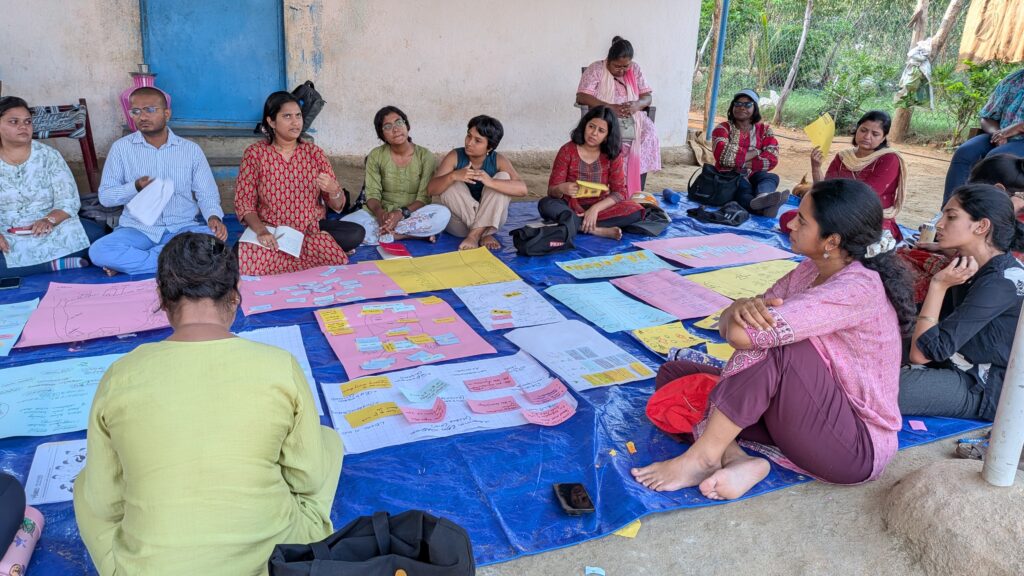
Recently, I spent a week at a workshop conducted by Praxis Institute of Participatory Practices, exploring participatory action research, positionality and ways of working more meaningfully with communities. Some of the language in this field can initially sound academic—positionality, paradigms, systems and structures, participatory action research, co-researchers. But underneath the terminology is a deceptively simple idea: people are not merely beneficiaries of the work we do. They are participants in creating the knowledge and solutions that shape that work.
To truly practise this means recognising the systems and structures that influence people’s lives—caste, patriarchy, capitalism and many others—and understanding how this shapes both the problems we see and the solutions we imagine. It also means examining our own position. Who are we as researchers, doctors, development professionals or NGO leaders? What power do we carry into a community? Whose knowledge do we consider legitimate? Who gets to decide what the problem is? Who gets to decide what success looks like?
These are not questions that can be answered in a one-week workshop. They require continuous reflection. And while the terminology may sometimes sound elaborate, actually putting these principles into practice—truly treating communities as co-creators and co-researchers rather than as subjects or beneficiaries—will take time.
Perhaps this is the biggest lesson I am learning as an Executive Director, community physician and public health researcher—three hats that I often find myself wearing simultaneously. Accountability does not mean always having certainty. It means being willing to ask difficult questions. It means being able to say: This is what we think is working. This is what we know. This is what we don’t yet know. This is what we are trying to understand.
It means listening when communities tell us that our assumptions were wrong. It means changing direction when the evidence tells us to. And it means resisting the temptation to manufacture certainty simply because certainty is easier to communicate.
SARF is still building systems, understanding communities, testing approaches and figuring out what it means to create meaningful and sustainable change in rural women’s health. There will be numbers. There will be outcomes. There will be failures. There will be course corrections. And, hopefully, there will be meaningful change that cannot always be captured neatly in a spreadsheet.
To everyone who has supported us, questioned us, encouraged us or challenged us: thank you. Your questions keep us accountable. My only request is that, alongside the questions, you give us something else that a young organisation needs just as much: time and patience.
Let us continue to learn. Let us continue to listen. Let us allow the work to evolve. Because sometimes, meaningful change begins not with having all the answers, but with having the courage to sit with the questions.
1 thought on “Sitting with Doubt and Uncertainties: Reflections from Our Executive Director on Running a Not-for-Profit in India”
Very well presented. May the Almighty bestow upon the organisation’s all that is aspired for. Godbless