
Food is a complex, everyday essential. Today, I write about food and nutrition among rural children around me. I work at the Streearogya Rural Foundation in Solapur, Maharashtra. Our organisation is a non-profit organisation that aims to improve the health of rural women and their families. Through our work and by collecting detailed nutrition information from the people here, we have begun to understand the eating patterns prevalent in the region. Most of the rural kids here eat home-cooked food on most days of the week/ month, unlike their urban counterparts, who may have greater access to fast food. Homemade food includes watery dal (lentils), chapati (flat wheat bread), preferred over bhakri (flat millet bread), rice, sparse/occasional vegetables, and seasonal fruits.
Every village has a small store (Kirana dukan), where most kids buy cheap packaged food like chips, biscuits, chocolates, and sweetmeats. Most kids have seen the inside of a supermarket in the city nearby. Some villages have small hotels/nearby ‘Dhabas’ that serve oily fast food. A favourite among rural kids seems to be vada pav (potato-stuffed gram flour fritters sandwiched between puffy refined wheat bread). Most homes have a smartphone with an internet connection, hence referring to food recipes on YouTube is common in some rural households. Most households consume much higher quantities of oil and salt per capita as compared to the World Health Organisation’s recommendations.
Festivals are a common occurrence, and there are many more local observances in rural areas as compared to the main few festivals in urban India. Food and fasting are central to the festivals and local religious fairs (jatras). In Maharashtra, there is a whole range of foods that are eaten during fasting- like fruits, dishes/preparations made from sabudana (sago grains), bhagar (barnyard millet), potato, and ratnalu (sweet potato). While most kids do not fast, they enjoy the festive and fasting preparations. Diwali, which we celebrated recently, saw kids enjoying the labour of the women in rural homes. Chakli, a savoury deep-fried snack that is made during the festival, has a mix of cereal and millet flours. Many more sweet and savoury snacks are together called ‘Diwali chya Faraal.’
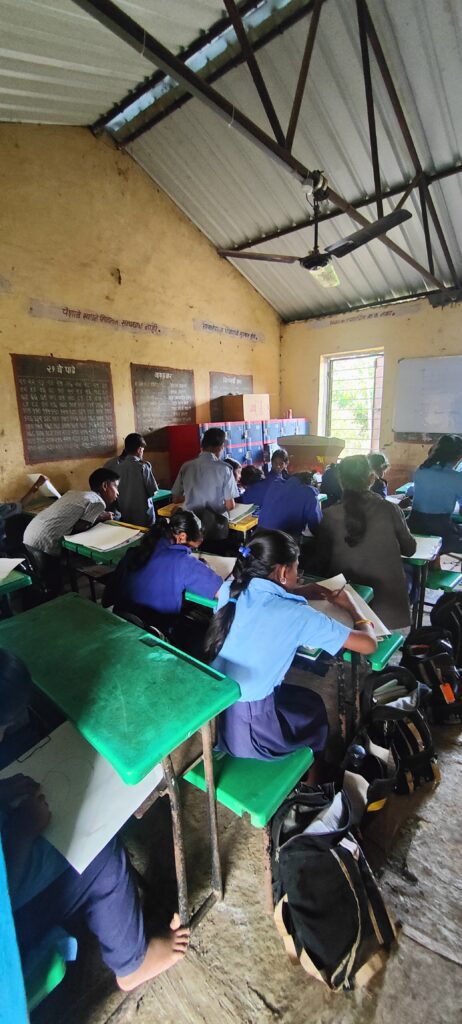
To understand children and their families’ views on what constitutes a healthy food plate, we organised a drawing competition in the village government school in August 2025. Children drew well, and brought food alive on paper. The trend towards non-local food was evident in the drawing sheets. Only two of the 55 students who participated mentioned hyper-local like varan (lentil gravy), amti (lentil gravy), and pandhra, laal rassas (meat curries). Most children drew panner gravy (cottage cheese gravy), which is not local to Maharashtra, but has achieved fame across the country due to restaurateurs’ entrepreneurial pursuits. As you can see from the pictures, the kids know a lot about what healthy food is. However, maybe they are unable to implement their knowledge due to various barriers.
The knowledge and the practice of healthy eating fall short, especially for the rural girls. Most girls are thin as per their body mass index, and have anemia, micronutrient deficiencies. We are aware that there are subtle social norms around food that put girls at a disadvantage. We commit to unravelling these social structures and exploring how nutrition and overall health can be improved for rural children and their families.
In contrast, many affluent/upper-middle-class urban kids have a problem of excess continuous feeding, grazing, and frequent snacking, leading to childhood obesity. With access to open spaces in villages, fewer restrictions to physical activity, lower access to fast food (no Swiggy, Zomato, or a hoard of birthday parties at fancy restaurants/ cafes), childhood obesity is not yet common in rural areas. However, among girls, as they reach their late teens, as study time increases, indoor household time increases, outdoor time decreases or ceases to exist in view of personal safety, we do see young adult women with obesity, PCOS.
Overall, we need interventions that understand the social nuances of rural children and adolescents. There is space, and most are farm households, so vegetable patches, microgreens are a feasible option. Foremost is for people to be aware of their own eating patterns, choices, while making mindful choices.